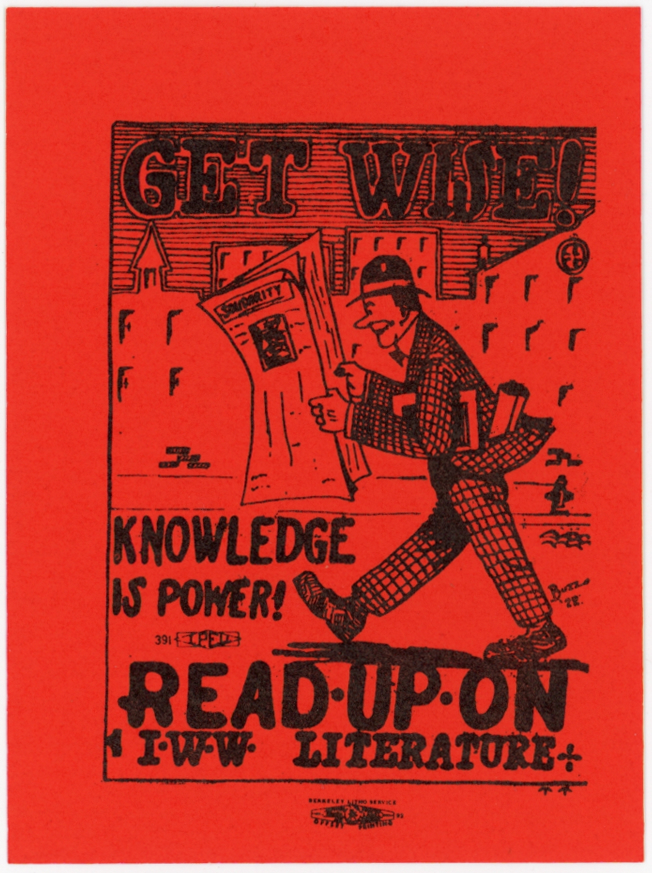
Use of AI to transcribe 1906 I.W.W. sticker and early newspaper clippings

I’ve been using Anthropic’s Claude (Opus 4.7) over the weekend to transcribe text found in early 20th-century I.W.W.-related advertisements and newspaper clippings and to provide accompanying Library of Congress subject headings, in order to catalogue a digital image collection I’m curating in JSTOR called History of I.W.W. Silent Agitators” or “Stickerettes. In doing so and without me prompting it to, Claude offered additional commentary and analysis for each item being catalogued, identifying themes as it went, a chronology, historical references, patterns over time, etc. I then asked Claude to summarize the several items it had transcribed, and the results are…

FOIA Request – September 5, 1917, Raids on I.W.W. Offices

Last week, I submitted a Freedom of Information Act (FOIA) request to the Department of Justice. Per the FOIA website, “Since 1967, the Freedom of Information Act (FOIA) has provided the public the right to request access to records from any federal agency. It is often described as the law that keeps citizens in the know about their government.” The FOIA request was related to my research on I.W.W. “stickerettes” listed in FBI case files from 1917-1918 that I wrote about in my previous post. FBI agents produced the case files in response to the September 5, 1917, government raids…

“Stickerettes” in early FBI Case Files

A few years ago, I had temporary free access one weekend to Fold3.com and quickly took some screen shots of early documents that contained the word “stickerettes” created by the Industrial Workers of the World (I.W.W.). Most documents looked like detailed inventory lists, but at the time, I didn’t save the bibliographic citations. In my ongoing research on the history of stickerettes, however, I came across the screen shots again and decided to track down more information. Here is what I’m learning. Most of the documents are reports made after the U.S. Department of Justice raided hundreds of I.W.W. offices…

I.W.W. members accused of sedition for using “stickerettes,” 1917-1918

For the past few years, DJ Alperovitz, an I.W.W. uber-archivist who lives in the Pacific northwest, has very kindly been sending me old newspaper clippings documenting early examples of I.W.W. “stickerettes” or “silent agitators” from such newspapers as Solidarity and Industrial Worker. You can read my essay about the early history of stickerettes, for example, and see a timeline at the links provided here. Up until now, I’ve been focused on finding the earliest examples of political stickers made in the USA. All roads have led to the I.W.W., though I’ve also found some stamps related to women’s suffrage from…

ChatGPT 4o for certain writing tasks

In preparation for a book I’m putting together, I asked ChatGPT 4o to create an index of my chapter on the early history of I.W.W. “stickerettes” or “silent agitators.” It took less than a minute for AI to generate the following: Index A B C D E F I J L M N O P R S T U V W Y Feel free to adjust the page numbers according to the actual layout of your chapter.

Eight new I.W.W. “silent agitators” + cataloguing with ChatGPT 4o

I recently acquired eight new I.W.W. “silent agitators” or “stickerettes,” bringing my collection up to 86 unique designs. That number is misleading, however, in that some designs are printed in different combinations of red and black ink on cream or red paper. Some designs have the addresses of I.W.W. headquarters listed on them, and some do not, which can help date the stickerettes. The address at 2422 North Halsted Street, Chicago, IL 60614 dated from April 1933 to February 1970, however, so most of the stickerettes date to that time period. The first stickerette below on red paper is one…

I.W.W. “stickerettes” in 1917 publication + other blog posts on “stickerettes”

I found another early reference to I.W.W. stickerettes from The International Socialist Review dated February 1917 (Vol. XVII, No. 8, page 455). An article called “Hitting the Trail in the Lumber Camps” by Harrison George states, “WHILE the Lumber Workers’ Union, the bull-pup of the Industrial Workers of the World, was in convention at Portland, Ore., during the last week of December, the rumblings of revolt began half way across the continent among workers of that industry in Minnesota. North and westward of the Mesaba Iron Range lies millions of acres of swamp lands. In the primeval state, these swamps…

I.W.W. stickerettes at Cornell University

I made another trip to Cornell last month to look at the I.W.W. stickerettes in the Kheel Center for Labor Management Documentation & Archives at the Catherwood Library. Cornell has quite a collection of I.W.W. materials, in fact. I was particularly interested in the collection 5210G (Boxes 1 and 9). One of the pages in the scrapbook below called the little adhesives “dodgers,” too, but I’ve never seen that term used before. Some were printed by an I.W.W. office at 308 Stewart Avenue in Ithaca, NY. The librarian told me that “Vernon Briggs Jr. donated the materials in 5210G, but…

Early history of I.W.W. “stickerettes” or “silent agitators”

[Note: a shorter version of this essay first appeared as “Silent Agitators: Early Stickerettes from the Industrial Workers of the World” in Signal: A Journal of International Political Graphics & Culture. Volume 6 (February 2018), PM Press. See also the timeline I put together of early advertisements and newspapers articles about I.W.W. stickerettes.] Founded in Chicago in 1905, the Industrial Workers of the World (I.W.W. or “Wobblies”) fought for economic justice for the working class using many tactics, including the widespread use of cartoons, slogans, leaflets, poetry, and songs that appealed to uneducated, immigrant, and itinerant workers. As early as…

I.W.W. “stickerettes” or “silent agitators” newspaper articles and advertisements – timeline

Special thanks to DJ Alperovitz and the I.W.W. Materials Preservation Project for sending me the earliest example of a stickerette from 1906 and for the advertisements from the I.W.W. newspapers Solidarity and Industrial Worker (primarily 1910-1917 with some later ads done in the 1920s, 1930s, and 1990s). The other newspaper articles reported on Ralph Chaplin, who designed many of the first stickerettes, and the over 100 I.W.W. members who were arrested by the U.S. government in September 1917 for alleged acts of sabotage under the Espionage Act of 1917. Ralph Chaplin edited Solidarity from March 10 through September 6, 1917,…